Spinel cut en cabochon: star stones showing asterism, opaque black material, and richly included rough. How cabochons are cut, oriented and judged, who they suit, and what natural spinel cabochons are worth in 2026.
A spinel cabochon is a spinel shaped with a smooth, polished dome instead of faceted planes, a cut reserved for stones that reward it: star spinels showing asterism, opaque black material, and richly included or softly translucent rough whose character reads better under a dome than through a brilliant crown. It is the considered exception to spinel's usual faceted brilliance.
Faceting is the default for spinel, and for good reason: a well-cut faceted spinel is singly refractive with a lively return of colour, and the material is rarely treated, so cutters chase brilliance with confidence. The cabochon is the deliberate alternative. When a stone carries a silk-forming inclusion network, sits fully opaque, or shows a colour that pools more beautifully in a dome than it scatters through a crown, a good cutter reaches for the cabochon wheel rather than the facet lap. Knowing which stones belong under a dome is one of the quieter skills in the trade, and it is where a great deal of spinel rough that never makes the faceting bench finds its best expression.
Why cut a spinel en cabochon instead of faceting it?
A cabochon is chosen when facets would work against the stone rather than for it. Asterism, heavy silk, opacity, and certain soft translucent colours all read better under a polished dome than through a faceted crown. Faceting relies on clean windows and sharp internal reflection; it flatters transparent, eye-clean rough that can bounce light back to the eye. But a large share of spinel rough is not transparent and eye-clean at all — it is included, silky, saturated to opacity, or simply too heavily veiled to face up brilliantly. For that material the cabochon is not a compromise; it is the correct decision. A dome gathers and concentrates colour, softens the reading of inclusions into an even glow, and — crucially — is the only cut that can reveal a star. Our guide to clarity, cut and shape covers where the line between faceting and cabbing usually falls, and why the same rough can be worth more domed than forced into facets it cannot support.
What is a star spinel, and how does asterism form?
A star spinel is a cabochon that shows a moving band of light — a four-ray or, more rarely, six-ray star — floating across its dome as the stone is turned under a single light. The effect, called asterism, comes from light scattering off oriented needle-like inclusions inside the stone. In spinel those needles are usually fine included crystals or exsolved oxides arranged along the crystal's cubic directions; because spinel is isometric (more on its crystallography), the geometry most often yields a four-rayed star, though six-ray and blurred multi-ray examples do exist. Star spinel is genuinely scarce — far rarer than star sapphire or star ruby — and most fine examples come from Sri Lanka, Myanmar, and occasionally Vietnam. Bodies tend toward grey, mauve, violet, pink and, at their best, a soft red. For the full picture, see our dedicated star spinel guide.
- Ray sharpness — crisp, unbroken rays beat soft, smoky ones
- Centring — the star should sit at the top of the dome and stay put as you rotate the stone
- Mobility — a good star glides smoothly across the dome under a moving light
- Body colour — an attractive, even ground colour lifts the whole stone
- Dome proportion — a well-judged height that presents the star without going glassy or dead
Because the star is created by inclusions rather than in spite of them, cutting a star spinel is a gamble taken before the wheel ever touches the stone. A cutter reads the silk in the rough, commits to an orientation, and only learns whether the star is sharp, centred and mobile once the dome is shaped and polished. That is part of why fine star spinels are so scarce and so prized: the material is rare to begin with, and even good rough can disappoint under the light. When a stone does deliver a crisp, well-centred four-ray star over an attractive body colour, it becomes a genuine one-of-one — the kind of connoisseur's piece that rewards patient collecting rather than casual buying.
Which spinel makes good cabochon material — black, grey, and included stones?
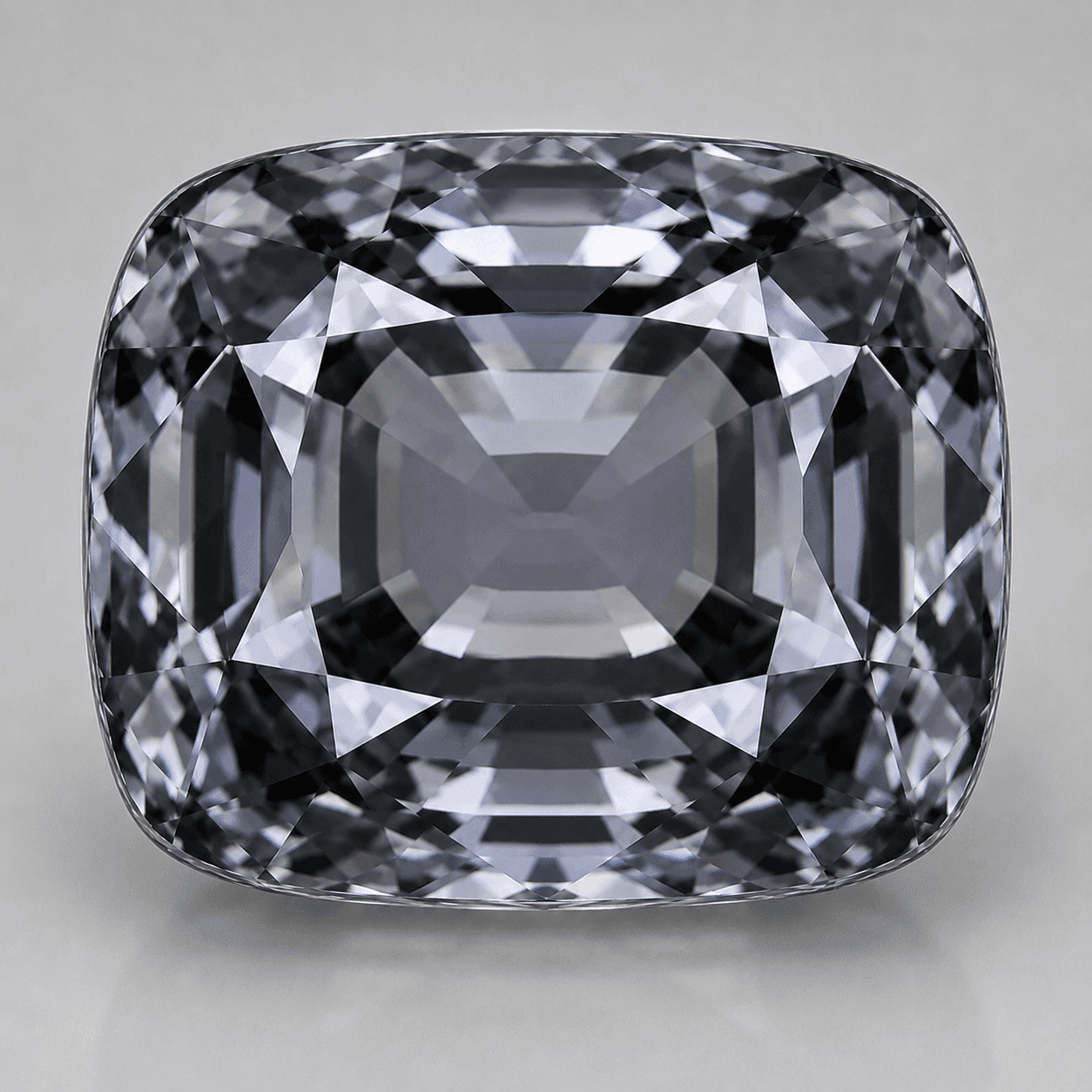
Three families of rough dominate the cabochon bench: opaque black spinel, grey and silky material, and richly included or translucent colours. Each is domed for a different reason. Black spinel is fully opaque, takes a mirror polish, and has become a staple of modern beaded and cabochon jewellery — its even, jet finish reads as quietly luxurious; read more in our black spinel guide. Grey spinel — steely, smoky, sometimes lightly silked — is often cabbed when the silk is too heavy for a clean facet return, and it makes some of the most affordable natural spinel on the market; the grey spinel guide covers the colour in depth. And across the wider palette, any saturated or heavily included stone — a deep red with visible fingerprints, a translucent lavender, a zoned pink — may be domed to keep the colour rich and calm the inclusions into a soft glow. Spinel's inclusions are part of its identity and its proof of natural origin; our inclusions guide explains what those veils and needles actually are.
| Cabochon type | Typical look | Why it is cabbed | 2026 value context |
|---|---|---|---|
| Star spinel | Four- or six-ray star over a grey, mauve, pink or violet body | Only a dome can reveal asterism | Scarce; fine stars carry a real premium over plain cabochons |
| Black spinel | Fully opaque, mirror-black polish | Opaque — no facet return is possible | Modest per carat; valued by size, polish and matching |
| Grey / silky | Steely, smoky, soft sheen | Silk too heavy to facet cleanly | Grey faceted often ~$300-500/ct; cabochons typically below that |
| Included colour | Translucent red, pink, lavender or violet | Preserve colour, soften inclusions | Follows colour and size; well under eye-clean faceted stones |
How is a spinel cabochon cut and oriented?
Cutting a cabochon is less about brilliance and more about orientation and symmetry. For star stones the entire value hinges on getting the dome axis right — a misjudged orientation buries the star or throws it off-centre for good. Spinel's Mohs 8 hardness and complete lack of cleavage make it forgiving to grind and safe to wear, but it still demands patience on the polish. Here is how a lapidary typically approaches spinel cabochon rough:
- Examine the rough under a strong point light, rotating it to map silk direction, colour concentration, and any latent star.
- Orient the future dome so its base sits perpendicular to the needle network — for a star, this centres the rays at the top of the dome.
- Saw or grind a flat, even base, then rough out the dome on a coarse wheel while keeping the girdle outline symmetrical.
- Set the dome height to the material — higher for a crisp star or deep colour, lower and softer for translucent stones meant to be read face-up.
- Sand through progressively finer grits, then polish spinel's hard surface to a bright, scratch-free finish with no flat spots or pits.
- Check the star or sheen under a single light and correct any asymmetry before the final polish is locked in.
How are cabochon spinels judged and priced?
Cabochons are judged on a different scale from faceted spinel, but the logic still begins with colour and phenomenon. For a star stone, ask four questions: are the rays sharp and complete, is the star centred and mobile, is the body colour attractive, and is the dome well-proportioned? For plain cabochons, polish quality, symmetry and colour do the work — a glassy, even dome with no flat spots is the mark of good cutting. Value sits well below fine faceted spinel in most cases: grey and black cabochons are among the most accessible ways into natural, untreated spinel, while a fine star can carry a genuine premium for its rarity — yet even a superb star spinel usually remains a fraction of the price of a comparable star ruby or star sapphire. The GIA spinel buyer's guide frames the wider quality factors, and our own spinel price guide sets the 2026 ranges. As always, phenomenon and one-of-one character — not carat weight alone — drive what a stone is truly worth.
What shapes, sizes and settings suit cabochon spinel?
Spinel cabochons are cut in oval, round, cushion and sugarloaf outlines, with ovals and rounds dominating for star stones because a symmetrical dome centres the rays most cleanly. Black spinel is also cut as beads and flat-backed shapes for pave-style and channel work, while grey and translucent cabochons often appear as low, soft domes designed to read face-up rather than throw a phenomenon. Size matters differently here than with faceted stones: a cabochon carries more weight for its face-up spread because of the dome, so a five-carat cab looks smaller than a five-carat brilliant. For settings, a bezel protects the exposed dome and frames the colour beautifully, while a half-bezel or east-west mount flatters an oval star. Matched pairs and small suites — for earrings or a beaded strand — command a premium simply because assembling consistent colour and polish across several stones is difficult and time-consuming.
A dome hides nothing a good eye cannot see — it simply asks you to judge colour, symmetry and star instead of sparkle.
Who suits a cabochon spinel, and where do you find one?
Cabochon spinel suits collectors who value phenomenon and character over pure brilliance, and anyone who wants natural, untreated spinel at a gentler entry point. A star spinel is a connoisseur's stone, prized for a phenomenon that faceted material can never show; black and grey cabochons are quietly versatile — excellent for men's pieces, signet rings, and understated modern settings that let the stone's surface do the talking. Because spinel is Mohs 8 with no cleavage, a cabochon wears well in daily jewellery, though a domed top sits more exposed than a protected faceted stone, so a bezel setting is the sensible choice. To see what is available across colours and cuts, browse the full collections or the shop; for grounding in the species first, start with our complete guide to natural spinel and the survey of the many colours of natural spinel. A cabochon may be the most honest introduction to spinel there is — colour and character, with nowhere to hide.
- Is a cabochon spinel worth less than a faceted one?
- Usually yes for equivalent colour and size, because most cabochons are cut from included, opaque or silky rough that could not be faceted cleanly. The clear exception is a fine star spinel, whose rarity can command a premium. Grey and black cabochons are among the most affordable natural spinels you can buy.
- What causes a star in spinel?
- Asterism comes from light reflecting off oriented needle-like inclusions inside the dome. Because spinel is isometric, those needles usually align to give a four-ray star, though six-ray examples exist. Only a cabochon cut, correctly oriented, can reveal the effect — a faceted stone never shows it.
- Is black spinel natural or treated?
- Fine black spinel is a natural, untreated colour caused by iron, and spinel as a species is very rarely treated, unlike most sapphire. Be cautious with very cheap black 'spinel' beads, which can be glass or reconstituted material — buy from a dealer who properly identifies the stone.
- How durable is a cabochon spinel in a ring?
- Very. Spinel is Mohs 8 with no cleavage, so it resists scratching and chipping well and wears beautifully over time. The domed top is more exposed than a faceted stone, so a bezel or otherwise protective setting is wise for a ring meant for daily wear.
- How can I tell a real spinel cabochon from an imitation?
- Natural spinel is singly refractive, Mohs 8, with a specific gravity around 3.60 and characteristic inclusions. A gemmologist confirms it quickly; for buyers, see our guide on how to tell if a spinel is real. Reputable dealers always disclose species and, where known, origin.
Sources
Facts on this page draw on independent gemmological authorities:
- Gemological Institute of America (GIA) · Institute
- Gübelin Gem Lab · Laboratory
- GRS (GemResearch Swisslab) · Laboratory
- Lotus Gemology · Laboratory