Spinel or a lab-grown diamond for your ring? One is a rare natural coloured gem, the other a manufactured colourless brilliant. We compare durability, look, price, ethics and resale so you can choose well.
Choosing between spinel and a lab-grown diamond for a ring means choosing between two fundamentally different propositions: a lab-grown diamond is genuine, laboratory-grown diamond — pure carbon, Mohs 10, blazing with fire yet almost always colourless — while natural spinel is a rare, untreated coloured gem, Mohs 8, prized for its genuine hue rather than its sparkle. Neither is an imitation of the other; they answer different desires. One offers a maximally brilliant white stone at a fraction of mined-diamond cost, the other a one-of-one natural colour with a collector's provenance. This guide sets them side by side across durability, look, price, ethics and resale, so you can match the stone to the ring you actually want. If you are also weighing earth-mined stones, our spinel versus mined diamond comparison is a useful companion piece.
A quick word on language, because it trips people up. A lab-grown diamond is real diamond: identical chemistry, crystal structure and optical properties to a stone pulled from the earth, grown instead in a reactor over weeks. Natural spinel is also real — a naturally occurring mineral that formed over millions of years in the marble belts of Myanmar, Tanzania and beyond. The word that matters here is not 'real' versus 'fake' but natural coloured gem versus manufactured colourless brilliant. For the difference between natural and laboratory-grown spinel specifically, see natural versus lab-created spinel.
What is the real difference between spinel and a lab-grown diamond?
The core difference is category: a lab-grown diamond is a manufactured version of a colourless brilliant, while natural spinel is a rare, earth-formed coloured gemstone. They share almost no gemmological properties beyond both being hard enough for a ring. One is chosen for the absence of colour, the other for the presence of a remarkable one.
Diamond is crystallised carbon, cubic, with a refractive index of 2.42 and dispersion of about 0.044 — the physics behind its famous fire. Spinel is magnesium aluminium oxide (MgAl2O4), also cubic and singly refractive, but with a gentler RI of roughly 1.712 to 1.762 and dispersion near 0.020. That single refractivity matters: spinel shows no pleochroism and no facet-doubling, giving colour a clean, calm quality rather than a busy shimmer. Lab-grown diamond is produced by two methods — CVD (chemical vapour deposition) and HPHT (high pressure, high temperature) — both yielding genuine diamond that a laboratory can only distinguish from mined material by trace growth features. Spinel, by contrast, is almost never treated at all; untreated is the norm, which is striking when you remember that around 90% of blue sapphire on the market is heated.
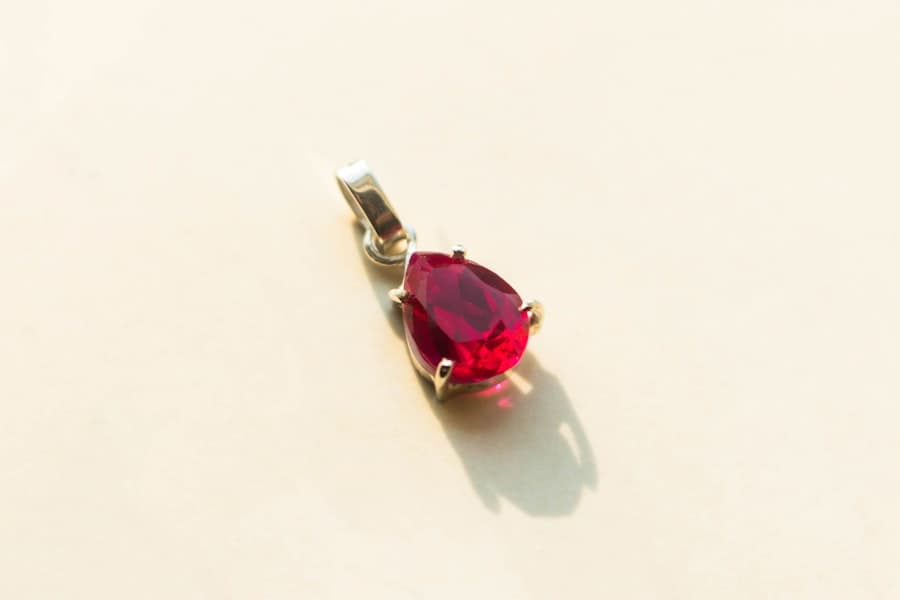
Spinel earns its place through colour. Chromium lends the glowing reds and hot pinks; cobalt produces the electric, almost neon blue that collectors chase; iron gives greys, denim blues, violets and lavenders. Green and yellow spinel are genuinely scarce. A lab-grown diamond, meanwhile, is valued for the absence of colour — the nearer to D-colourless, the better — with fancy-coloured versions a niche. So the two stones sit at opposite ends of the desire spectrum: one is chosen because it is colourless, the other because its colour is extraordinary. Our red spinel guide shows how far that colour can go.
Is a lab-grown diamond more durable than spinel for everyday wear?
Yes, a diamond is harder — Mohs 10 versus spinel's Mohs 8 — so it resists scratches better over decades of daily wear. But spinel is still an excellent ring stone: it has no cleavage, takes knocks well, and comfortably outlasts most coloured gems. For most wearers the practical difference is smaller than the numbers suggest.
Hardness measures scratch resistance, and diamond is the hardest natural material known, sitting at the very top of the Mohs scale. Spinel's 8 is genuinely high — the same neighbourhood as sapphire — and well above quartz at 7, the benchmark for everyday durability. What often gets overlooked is toughness, the resistance to chipping and fracture. Diamond, despite its hardness, has perfect cleavage and can cleave along a plane if struck at the wrong angle. Spinel has no cleavage at all, so it tends to resist chipping gracefully. For an engagement ring worn every day, both are safe; the edge goes to diamond on scratch resistance, while spinel closes the gap on toughness. We cover this in depth in spinel hardness and durability.
For either stone, the setting does much of the protective work. A bezel or half-bezel shelters edges; a well-made prong setting keeps the girdle clear of daily knocks. Because spinel is marginally softer, a jeweller may recommend a slightly more protective mount for a ring destined for constant wear — a small consideration, not a deal-breaker. See spinel settings and metals for how to pair stone and mount, and our spinel engagement ring guide for ring-specific advice.
Which looks better in a ring — colourless brilliance or natural colour?
Neither is objectively better; they create opposite effects. A lab-grown diamond delivers maximum white sparkle and fire, while spinel offers depth of natural colour and a soft, glassy lustre. The right answer depends entirely on whether you want your ring to read as brilliance or as colour.
Under the lights, a diamond's high refractive index and 0.044 dispersion throw prismatic flashes — the 'fire' that defines the look. If you want a ring that reads as a classic colourless sparkler, lab-grown diamond gives you exactly that, indistinguishable to the eye from a mined one. Spinel plays a different game. Its lower dispersion means less rainbow fire, but its single refractivity and fine transparency give colour a pure, luminous quality — a red spinel glows, a cobalt-blue seems lit from within. On the hand, spinel makes a statement of colour and individuality; a diamond makes a statement of brilliance and tradition. Grading a coloured gem is about colour first, and GIA's spinel buyer's guide is a sound primer on how the pros look at hue, tone and saturation.
There is also the matter of presence. Because spinel is a coloured stone, even a modest one-carat example commands attention on the finger in a way a comparably sized colourless stone may not. Collectors often describe spinel as the connoisseur's choice precisely because it is not the default. If you love blue, the electric hues in our cobalt-blue spinel guide have no equivalent in any diamond. If it is sheer sparkle you are after, a diamond — grown or mined — will always win on fire.
A lab-grown diamond answers the question 'how bright?'. A natural spinel answers 'what colour, and how rare?'
How do prices compare, and what about resale value?
Lab-grown diamonds have fallen dramatically in price and now cost a fraction of mined diamonds, but they also depreciate steeply because supply is effectively unlimited. Fine natural spinel holds value better as a genuinely scarce natural resource, though neither should be bought purely as an investment.
Lab-grown diamond pricing has softened sharply as production has scaled — a one-carat lab-grown stone that cost several thousand dollars a few years ago can now be a few hundred, and prices continue to fall. That is wonderful for buying and unforgiving for reselling: because a factory can make more tomorrow, the second-hand value of a lab-grown diamond is typically very low. Natural spinel sits on the opposite footing. It is a finite natural material, and fine examples are rare. In 2026 terms, fine red spinel runs roughly $2,000 to $10,000+ per carat, top cobalt-blue can exceed $20,000 per carat, while grey spinel remains accessible at around $300 to $500 per carat. Notably, fine red spinel often costs about one-tenth of a comparable ruby — a value story lab-grown diamond cannot tell.
| Property | Natural Spinel | Lab-Grown Diamond |
|---|---|---|
| Origin | Naturally formed, earth-mined | Manufactured (CVD or HPHT) |
| Composition | MgAl2O4 (magnesium aluminium oxide) | Crystallised carbon (real diamond) |
| Crystal system | Cubic, singly refractive | Cubic, singly refractive |
| Mohs hardness | 8 | 10 |
| Cleavage | None | Perfect (can chip if struck) |
| Refractive index | ~1.712-1.762 | 2.42 |
| Dispersion (fire) | ~0.020 (soft) | ~0.044 (high) |
| Colour | Natural red, pink, cobalt-blue, grey, lavender and more | Near-colourless (D-Z); fancy colours niche |
| Treatment | Very rarely treated; untreated is the norm | N/A (fully synthesised) |
| Rarity | Finite natural resource; fine colours rare | Reproducible in unlimited quantity |
| Approx. 1ct price (2026) | Grey ~$300-500; fine red $2,000-10,000+; cobalt $20,000+ | A few hundred dollars and falling |
| Resale outlook | Holds value; rarest colours can appreciate | Depreciates steeply |
On resale, be realistic about both. A lab-grown diamond will likely fetch a small fraction of its purchase price. A fine natural spinel from a good source, bought well, tends to hold value better and can appreciate for the rarest colours — though the coloured-stone market is illiquid and dealer margins are real. We set out the honest picture in is spinel a good investment and the spinel price guide. Buy the stone you love to wear; treat any future value as a bonus, never a promise.
Which is the more ethical and sustainable choice?
Both can be responsible choices, and both carry caveats. Lab-grown diamonds avoid mining but are energy-intensive to produce; natural spinel is artisanally mined with a comparatively light footprint but requires careful sourcing. There is no single 'greener' answer that survives scrutiny.
Lab-grown diamond is often marketed as the ethical option because no earth is moved to extract it. That is partly true — but growing diamond in a reactor consumes significant energy, and 'sustainable' claims deserve scrutiny about the power source. Natural spinel is typically recovered by small-scale artisanal miners in places like Mogok in Myanmar, Mahenge in Tanzania and Luc Yen in Vietnam, often by hand-sorting gravels, with a comparatively small environmental footprint. The ethical questions there concern labour conditions and traceability rather than industrial scale. A specialist dealer's job is to know the chain; read more in our note on ethical spinel sourcing.
There is a quieter point, too. A lab-grown diamond is, by design, reproducible — countless identical stones can be made. A natural spinel is a one-of-one: no two share the exact colour, inclusion signature or provenance. For many buyers that irreproducibility is the value, both emotionally and as a keepsake to pass on. Browse a few and the appeal becomes obvious — each stone in our collections is genuinely singular.
How do I choose between spinel and a lab-grown diamond for my ring?
Start with what you want the ring to say — colour and rarity, or colourless brilliance — then let durability, budget and provenance narrow it down. The two stones rarely compete once you are honest about the look you love. A short, practical sequence keeps the decision clear.
- Decide on the look: if you want a classic colourless sparkler, lean lab-grown diamond; if you want natural colour and individuality, lean spinel.
- Set your budget and be clear-eyed about resale — lab-grown depreciates, while fine spinel holds value better.
- Weigh daily wear: both are ring-worthy; opt for a protective setting if you are hard on your jewellery.
- Choose your colour, for spinel: red, hot pink, cobalt-blue, grey or lavender — each has its own character and price.
- Insist on provenance: for spinel, buy untreated natural stones with clear origin; for lab-grown diamond, confirm it is disclosed and, ideally, certified.
- See the stone in person or on video before you commit, ideally against your own skin tone.
If you are torn, remember there is a third contender people often raise — moissanite — which we weigh up in spinel versus moissanite. But the honest summary is this: a lab-grown diamond is the right answer if colourless fire is the goal, and a natural spinel is the right answer if you want a rare, wearable colour with a story. When you are ready to see what natural colour looks like in the hand, explore the shop.
Ultimately, spinel and lab-grown diamond are not rivals so much as answers to different questions. If the dream is a brilliant, budget-friendly colourless stone, a lab-grown diamond delivers it honestly. If the dream is a rare, natural colour that no reactor can reproduce — a stone with provenance, character and a value that rests on genuine scarcity — spinel is the connoisseur's choice, and one the market is only beginning to appreciate.
- Is a lab-grown diamond a real diamond?
- Yes. A lab-grown diamond is chemically and optically identical to mined diamond — pure crystallised carbon, Mohs 10 — grown by CVD or HPHT rather than dug from the earth. It is real diamond, not a simulant like cubic zirconia or moissanite.
- Is spinel hard enough for an engagement ring?
- Yes. Spinel is Mohs 8 with no cleavage, making it durable enough for daily wear. Choose a reasonably protective setting and clean it gently, and a spinel ring will comfortably last a lifetime.
- Which is cheaper, spinel or a lab-grown diamond?
- For a colourless one-carat stone, lab-grown diamond is now very affordable and still getting cheaper. Fine natural spinel varies enormously by colour — accessible greys from a few hundred dollars per carat, fine reds and cobalt-blues climbing into five figures.
- Does spinel or lab-grown diamond hold value better?
- Fine natural spinel generally holds value better because it is a finite natural resource, whereas lab-grown diamonds depreciate as production scales. That said, neither should be bought purely as an investment — buy for the joy of wearing it.
- Can a jeweller tell spinel and lab-grown diamond apart?
- Instantly. They differ in almost every property — spinel is singly refractive with an RI near 1.72 and soft fire, while diamond has an RI of 2.42 and vivid dispersion. Standard gemmological testing separates them at a glance.
Sources
Facts on this page draw on independent gemmological authorities:
- Gemological Institute of America (GIA) · Institute
- Gübelin Gem Lab · Laboratory
- GRS (GemResearch Swisslab) · Laboratory
- Lotus Gemology · Laboratory