From soft pastel to neon Mahenge, pink spinel is the connoisseur's accessible entry into fine, untreated colour — here is how to judge and buy it in 2026.
Pink spinel is a natural magnesium aluminium oxide gem coloured by chromium, ranging from pastel rose to vivid neon Mahenge hot pink. Rarely treated and often a tenth the price of comparable ruby, it is the collector's most accessible route into fine, untreated spinel. As of 2026, expect roughly $100 to $5,000 per carat.
What Gives Pink Spinel Its Colour?
Pink is the chromium-coloured member of the spinel family. Chemically it is magnesium aluminium oxide (MgAl2O4), a cubic, singly refractive gem with a refractive index near 1.712 to 1.762, a specific gravity around 3.60, and a Mohs hardness of 8 that stands up to daily wear (more in our spinel hardness and durability guide). The same trace element that turns ruby and red spinel red — chromium — produces pink at lighter concentrations. Where iron enters the crystal lattice, the colour drifts toward mauve, greyish-pink or purple. The purest, most saturated pinks are chromium-driven and can glow gently under ultraviolet light, a quiet signature of the element behind the colour. For the wider chemistry and species background, see our complete guide to natural spinel.
The Colour Range: From Pastel Rose to Neon Hot Pink
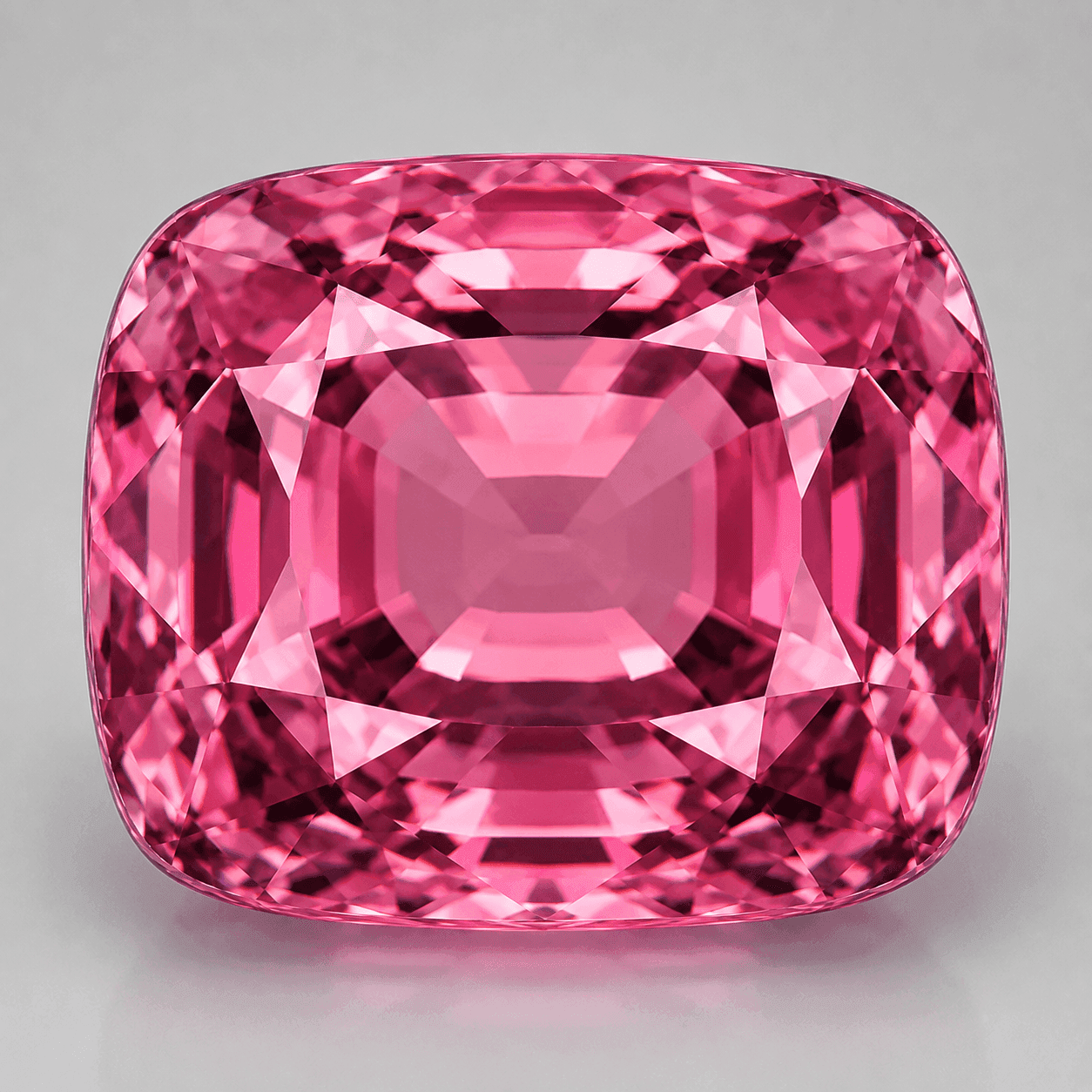
Few gems cover as wide a colour band. At one end sit soft pastel roses and baby pinks — light in tone, gently saturated and easy to wear every day. Move up the saturation scale and you reach bubblegum and rose pinks, then the vivid, almost electric 'hot pink' and neon material that defines the top of the market. Gemologically, three levers describe any stone: hue (from slightly purplish-pink to slightly orangey-pink), tone (how light or dark the colour sits) and saturation (how vivid it is). The pieces collectors chase combine a pure to slightly purplish-pink hue, a medium tone that keeps the colour glowing rather than washed out, and high saturation. We have handled everything from quiet pastels made for an everyday ring to neon crystals that hold a room — and the price gap between the two ends is considerable.
Where Does the Finest Pink Come From?
No account of pink spinel is complete without Mahenge. In 2007, a deposit in the Mahenge region of Tanzania produced neon pink and red spinel of a saturation the market had rarely seen — including several enormous crystals — and it is widely credited with reviving global interest in spinel as a collectable gem. Mahenge neon pink is the benchmark: a glowing, almost backlit pink driven by chromium with very little iron, which is exactly why the colour reads so pure. Not every stone from the region is neon, and not every neon pink is from Mahenge, but the name has become shorthand for the finest material. If the origin draws you, our Mahenge spinel guide goes deeper, and the closely related red spinel guide covers the chromium reds that share this chemistry.
Beyond Mahenge, the classic source of fine pink is Myanmar (Burma), where the Mogok valley has produced chromium-rich pink and red spinel for centuries alongside its famous rubies. Sri Lanka (Ceylon) tends to yield softer, more iron-influenced stones that lean lavender or greyish-pink — lighter, cooler and usually the most accessible entry point into the colour. Vietnam's Luc Yen is celebrated mainly for vivid blues and reds, yet it delivers clean, saturated pinks as well. Because each deposit gives up only modest quantities, fine material surfaces in small parcels rather than a steady stream, and a good stone in a wanted shade rarely stays available for long.
What Drives the Value of Pink Spinel?
Five factors set the price of any pink stone. Colour comes first: vivid, neon-leaning pinks command multiples of pale or greyish material. Size matters sharply, because clean, saturated stones above three or four carats are genuinely scarce — most fine rough is small. Clarity is judged eye-clean to the unaided eye; spinel's inclusions tend to be fine silk or small crystals rather than the heavy 'jardin' of some gems. Cut controls how much of that colour and brilliance you actually see, since spinel's single refractive index gives a clean, glassy return when the proportions are right. Origin adds a premium, with Mahenge and Burmese (Myanmar) stones leading. Finally, treatment: spinel is very rarely treated, so a natural, untreated pink is the default rather than something you pay extra to secure. These are broadly the criteria the GIA's spinel quality factors set out.
Two of those factors reward a closer look. On clarity, spinel is often among the cleaner coloured stones, so hold out for material that is eye-clean; fine internal silk can even lend a soft glow, whereas eye-visible fractures or dark crystals should pull the price down sharply. On cut, because spinel is singly refractive it has no doubling to hide behind — a lazy cut announces itself at once as a pale window through the centre, while precise proportions return light evenly across the whole face. In pink especially, the cut is often what separates a stone that merely is pink from one that genuinely reads as vivid and alive.
| Quality tier | Price per carat (2026) | What to expect |
|---|---|---|
| Commercial | ~$100-600 | Pale, greyish or very light pink; often included or windowed; small sizes |
| Good | ~$600-2,000 | Clearly saturated pink, eye-clean, well cut; ideal everyday collector stones |
| High | ~$2,000-5,000 | Vivid hot pink, eye-clean, better sizes; the entry point to neon character |
| Top | ~$5,000-10,000 | Neon Mahenge and fine Burmese pink; glowing colour in larger clean crystals |
| Exceptional | $20,000+ | Rare Myanmar and standout Mahenge crystals of benchmark saturation and size |
Because chromium colours both red and pink, pink trades within the same family as red spinel, and the tiers above reflect that shared market as of 2026. Even at the summit, a top red spinel — pink's chromium sibling — often sells for roughly a tenth of a comparable ruby, a gap that has nothing to do with beauty or durability and everything to do with name recognition. For the full picture across colours and sizes, see our spinel price guide and the broader question of whether spinel is valuable.
Pink Spinel vs Ruby and Pink Sapphire: The Value Case
For centuries, some of the most celebrated 'rubies' in the world were in fact pink and red spinels. The Black Prince's Ruby and the Timur 'Ruby' among the British Crown Jewels are both spinel, mistaken for ruby until modern gemology corrected the record. That history is the collector's argument in miniature: spinel offers the chromium-driven colour that made ruby famous, without ruby's price or, usually, its treatment. Around 90% of blue sapphire is heat-treated to improve colour, whereas spinel is very rarely treated at all — so a natural stone is almost always exactly what it appears to be. Set beside a pink sapphire or a ruby of similar colour, it offers comparable presence, excellent transparency from its single refractive index and, for the connoisseur who values the stone over the label, a more interesting story. It is worth being clear-eyed about the trade-off: ruby and sapphire still enjoy deeper name recognition and, on resale, a broader pool of ready buyers, so part of what you save on spinel reflects a younger, thinner market. For the collector who buys on the merits of the stone itself, that discount is the opportunity rather than the catch. Our spinel versus ruby comparison and spinel versus sapphire guide weigh these trade-offs in full.
How to Buy Pink Spinel: A Step-by-Step Approach
Buying a pink stone well is largely a matter of sequence. Work through these steps and you will sidestep the most common mistakes.
- Fix your priority first — decide whether you want a soft pastel for everyday wear or a vivid neon stone as a collector piece, because that single choice sets your budget.
- Judge colour in neutral daylight — look for a pure to slightly purplish pink at a medium tone, and set aside stones that read grey, brown or washed out.
- Check for windowing and eye-clean clarity — tilt the stone; a well-cut pink spinel stays saturated across the face and shows no see-through 'window' in the centre.
- Weigh size against rarity — remember that clean, saturated pink material above three carats is scarce, so genuine size premiums are worth paying for the right stone.
- Ask about origin and treatment — confirm the stone is natural and untreated, and whether any Mahenge or Burmese origin is being claimed.
- Require an independent certificate for anything significant — a report from a respected lab confirms species, natural origin and the absence of treatment before you commit.
- Buy from a specialist who stands behind the stone — a dealer who handles spinel daily can show comparison stones and explain exactly what you are paying for.
Why a Certificate Matters
For any significant pink spinel, an independent gemological certificate is not optional — it is how a seller's claim becomes an established fact. A respected laboratory confirms the stone is natural spinel rather than a synthetic or another species, states whether any treatment is detected, and often gives an origin opinion that materially affects value. The trade relies on reports from laboratories such as the GIA, Lotus Gemology and GRS, whose colour and origin criteria are published and consistent. For pink in particular, the origin line carries weight: a laboratory opinion of Mahenge or Burmese origin can lift value meaningfully, so it is worth asking for origin as well as species and treatment on the report. Because spinel is so rarely treated, most reports simply confirm no indications of treatment — but that single line is precisely what protects your position on resale. Our guide to spinel certification explains how to read one point by point.
Is Pink Spinel the Right Entry Into Fine Spinel?
If you are stepping into fine spinel for the first time, pink is arguably the ideal place to begin. It offers the chromium colour that defines the species' most famous stones, it is very rarely treated, and it spans a range — from about $100 for a pretty pastel to five figures for a benchmark Mahenge neon — that lets you start modestly and trade up as your eye sharpens. It wears well in practice, too: at a Mohs hardness of 8 a pink stone is hard enough for a daily ring with sensible care, and because it is almost never treated there is no fragile filler or surface coating to guard (our notes on caring for spinel cover the everyday). Spinel also joined peridot as an official August birthstone when the AGTA recognised it in 2016, which lends a pink stone both meaning and rarity for an August birthday. Every fine example is effectively one of one: cut from limited rough, in a colour and size pairing that will not be repeated. For the collector who would rather own something rare and undervalued than something merely expensive, that is the whole appeal.
When you are ready, explore our pink spinel collection, compare colours across the full range of loose natural spinel we keep in stock, or read the practical spinel buying guide before you commit. Whatever you choose, insist on an independent report for any significant stone — and buy the colour that stops you, because that is the one you will keep.
- Is pink spinel expensive?
- It is far more affordable than ruby or pink sapphire of similar colour. As of 2026, pretty commercial stones start near $100 per carat, good eye-clean pinks run $600 to $2,000, and vivid neon Mahenge material reaches $5,000 or more — still around a tenth of comparable ruby prices.
- What is Mahenge pink spinel?
- Mahenge pink comes from the Mahenge region of Tanzania, where a 2007 discovery produced neon, glowing pink and red crystals that revived the global spinel market. Coloured by chromium with very little iron, it is the benchmark for the purest, most saturated pink available today.
- Is pink spinel treated or heated?
- Almost never. Unlike sapphire — around 90% of which is heat-treated — spinel is very rarely subjected to any treatment, so fine pink material is typically natural and untreated. That is central to its appeal, though a laboratory report remains the only way to confirm it for a significant stone.
- Is pink spinel a good August birthstone?
- Yes. The AGTA added spinel as an August birthstone in 2016, alongside peridot, so a pink stone is a recognised and unusually rare choice for an August birthday. Its Mohs hardness of 8 and near-total absence of treatment make it both durable and honest for everyday wear.
- Pink spinel or pink sapphire — which should I buy?
- It depends on priorities. Pink sapphire is slightly harder and more widely recognised, but usually heat-treated. Spinel is very rarely treated, shows excellent transparency from its single refractive index, and costs far less for comparable colour — making it the connoisseur's value choice rather than the safe default.
Pink look-alikes trip up many buyers — see spinel vs rubellite tourmaline — and some of the finest pinks are Vietnamese, as our Vietnamese spinel guide explains. Explore pink further in our Jedi spinel guide, the pink vs red spinel boundary, and spinel earrings. See also spinel vs tourmaline and pink from a newer source in our Madagascar spinel guide.
Sources
Facts on this page draw on independent gemmological authorities:
- Gemological Institute of America (GIA) · Institute
- Gübelin Gem Lab · Laboratory
- GRS (GemResearch Swisslab) · Laboratory
- Lotus Gemology · Laboratory