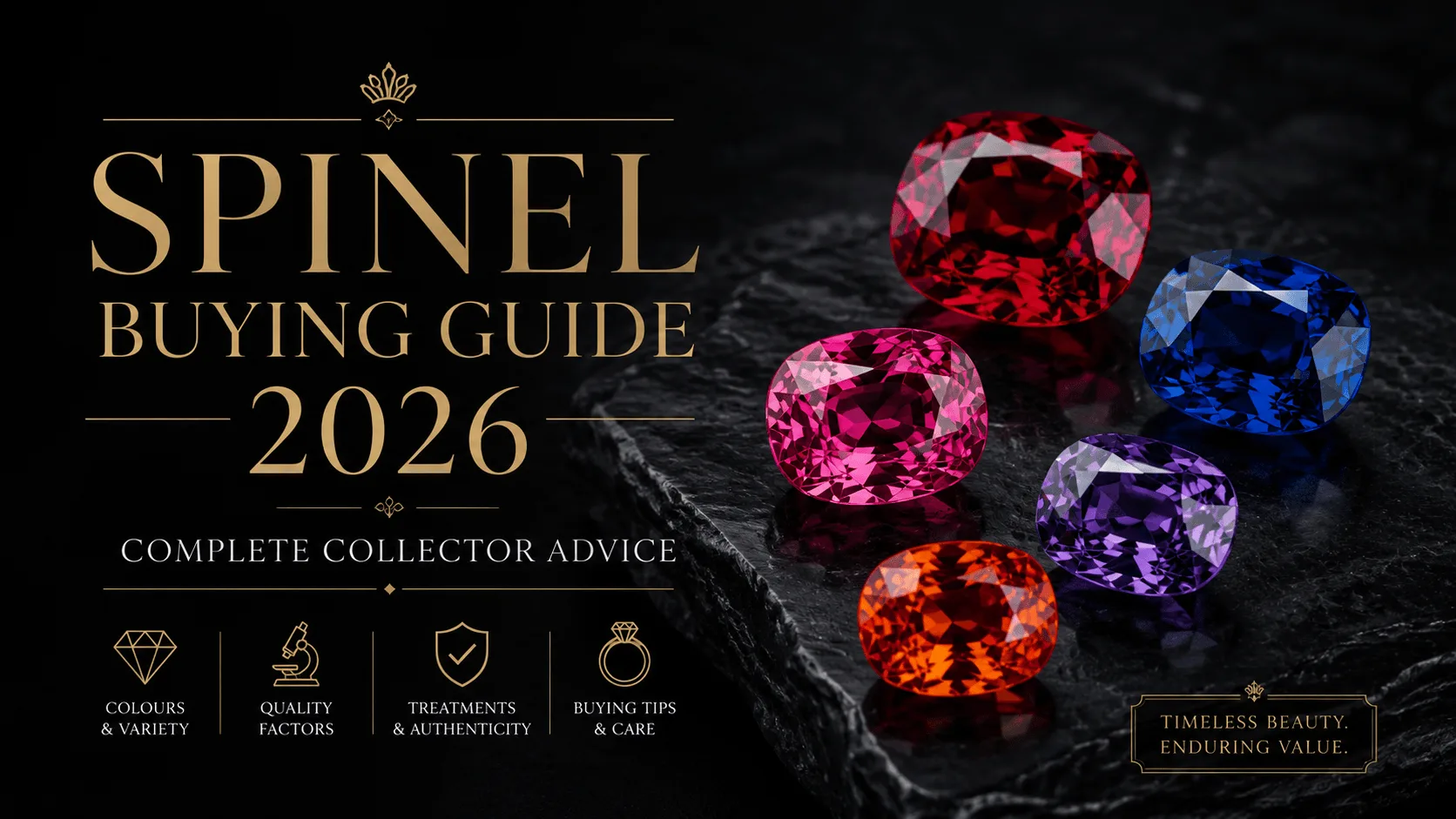
A dealer-and-gemologist spinel buying guide to the 4Cs, treatment, certification and 2026 prices by colour, so you can judge value and buy natural spinel with a collector's eye.
To buy natural spinel well, judge colour first — hue, tone and saturation decide most of the value — then reward eye-clean clarity, a lively cut and honest carat weight. This spinel buying guide shows how to read those factors, confirm the stone is untreated, and match price to quality in 2026.
Why Buying Spinel Is Not Like Buying Ruby or Sapphire
Spinel has never had a consumer grading system marketed the way ruby and sapphire do, and that gap is precisely why an informed buyer can do so well. For centuries the trade could not tell spinel and ruby apart — the Black Prince's Ruby and the Timur Ruby set in the British Crown Jewels are both spinels. That long confusion kept spinel out of the mainstream, and prices still carry the discount today: a top red spinel often sells for roughly one-tenth of a comparable ruby, while showing the same pure chromium red, cleaner clarity on average, and almost no heat treatment. The modern market only really woke up in 2007, when the neon pinks of Mahenge in Tanzania arrived and reminded collectors what this stone can do. What follows is written for the connoisseur who wants to buy on merit: read the detail like a dealer, and you buy quality the wider market has not finished pricing.
Colour: The Heart of Any Spinel Buying Guide
With spinel, colour drives roughly seventy per cent of the price, so it is where every spinel buying guide should start. Gemologists break colour into three parts. Hue is the colour itself — the chromium reds and hot pinks, the cobalt-driven neon blues, and the iron-influenced steely blues, greys and violets. Tone is how light or dark the stone is, from pale to near-black; the sweet spot sits in the medium range, bright enough to glow yet deep enough to read as a true colour. Saturation is colour intensity, and it is the single biggest value lever — the enemy is grey. A red with high saturation reads vivid and alive; the same red muddied by grey looks brownish and sells for a fraction. When you compare two spinels, ignore the labels and ask which colour is cleaner and more vivid in the same light.
Two habits separate a trained eye from a beginner. First, watch for colour zoning — uneven patches or bands of colour — and for a window, the washed-out area in the centre of a poorly cut stone where colour drains away. Second, judge colour in more than one light: iron-rich blues and some reds shift under warm indoor lamps, and a stone that only performs under the seller's light is telling you something. For a fuller tour of what each hue should look like, see our guide to the many colours of natural spinel. If you already know the colour you want, our red spinel guide and cobalt-blue spinel guide go deep on the traits that matter most in each.
The Spinel 4Cs at a Glance
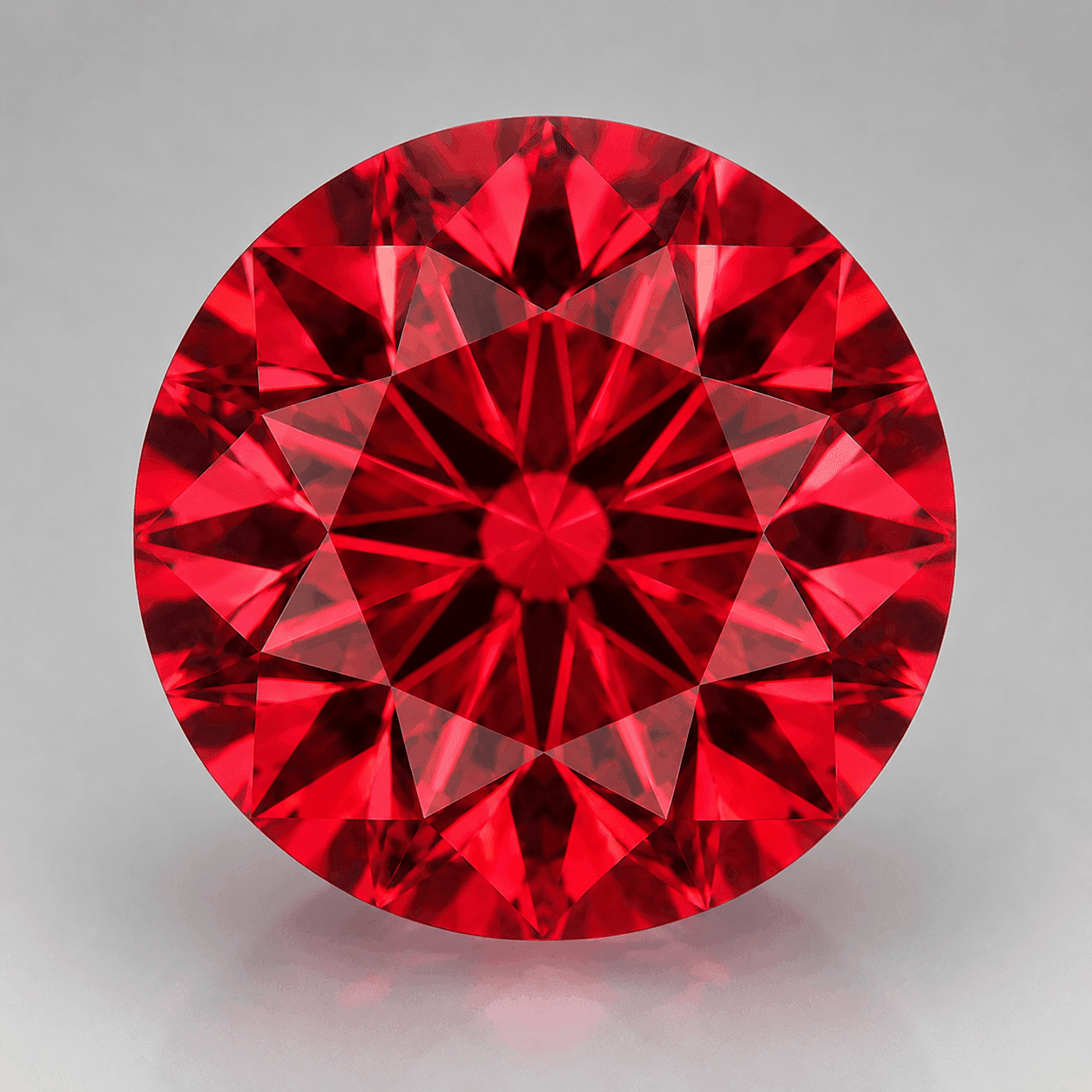
Diamonds made the 4Cs famous, but coloured stones weigh them differently. For spinel the order of importance runs colour, then clarity, then cut, then carat — almost the reverse of how many first-time buyers shop. Use the table below as a quick reference, then read the sections that follow for the detail behind each factor.
| The C | What to look for | Why it matters |
|---|---|---|
| Colour | Vivid, even hue; medium tone; high saturation with minimal grey | Drives the majority of value and is the first thing the eye and the market judge |
| Clarity | Eye-clean face-up; minor inclusions acceptable only under magnification | Spinel is often cleaner than ruby, so genuinely eye-clean stones carry a premium |
| Cut | Symmetry, bright even return of light, no central window, sensible depth | A precise cut lifts colour and brilliance; weight hidden below the stone does not |
| Carat | Weight judged against colour rarity, not size alone | Clean stones above 2 to 3 carats are scarce in fine reds and cobalt blues, so price per carat jumps |
How Do You Judge Clarity, Cut and Carat?
Clarity is where spinel quietly beats its rivals. Because it often forms in cleaner conditions than ruby, fine spinel is frequently eye-clean, meaning no inclusions are visible to the naked eye when you look straight down at the face. When inclusions are present they are usually tiny octahedral crystals (often spinel within spinel), fingerprint-like healed fissures, or short needles. A few of these under magnification are normal, and they can even help confirm a stone is natural rather than synthetic. What you pay a premium to avoid is anything eye-visible face-up, a haze that dulls the colour, or a fracture that threatens durability. Ask the seller plainly whether the stone is eye-clean, and at what distance.
Cut is the factor buyers most often undervalue. Spinel is singly refractive with a refractive index around 1.712 to 1.762, so a well-cut stone returns light crisply and lets the body colour glow. A poor cut shows a window in the centre, dark extinction zones, or a lumpy pavilion that hides weight beneath the stone. Much spinel is cut at or near its source to save weight, which is why you will meet off-round outlines and slightly deep stones; that is not automatically a fault, but a precision-cut or recut stone will almost always look livelier. Judge cut by how evenly light bounces back across the whole face as you rock the stone gently.
Carat is simple arithmetic until rarity intervenes. Spinels up to a carat are relatively available in most colours, so price per carat stays modest. But clean, well-saturated stones above two to three carats are genuinely scarce in fine red and cobalt blue, and price per carat then climbs steeply, sometimes doubling or more at each size threshold. This is where true one-of-one scarcity sets in: a five-carat, eye-clean, vivid Mahenge or Luc Yen stone is not a larger copy of a one-carat stone, it is a different order of rarity. For a full breakdown of how the four factors stack into a final number, see our spinel price guide.
Why Untreated Spinel Matters
Here is one of spinel's strongest arguments, and a core reason this spinel buying guide keeps returning to it: the stone is very rarely treated. Roughly ninety per cent of blue sapphire on the market is heat-treated to improve colour, and most ruby is heated or filled. Fine spinel, by contrast, is almost always sold exactly as it came out of the ground — no heat, no diffusion, no glass filling — and cobalt-blue spinel in particular is almost never treated. That matters twice over. First, you are buying a natural colour rather than a furnace-assisted one, which is exactly what a connoisseur wants. Second, untreated status protects value: as the wider market learns how clean spinel's story is, the unheated stones with lab confirmation are the ones that keep attention. If a seller cannot state treatment status, treat that as a reason to slow down, not to hurry.
One caution belongs here. Synthetic spinel has been mass-produced for more than a century, mostly for inexpensive birthstone jewellery and imitation gems, and it can look convincingly natural to the unaided eye. It is not an earth-formed stone and should never command the same price. If a deal looks too good — a large, flawless, intensely coloured stone at a bargain — assume synthetic until proven otherwise. Our guide to natural versus lab-created spinel explains the tells, and how to tell if a spinel is real walks through the simple checks to run before you commit.
Does Origin Change What You Should Pay?
Origin is not a colour grade, but it does move price, and a good spinel buying guide should be honest about how much. Four sources dominate the fine market. Mogok in Myanmar (Burma) produces the classic, slightly warm chromium reds that collectors treat as the benchmark, and exceptional Burmese reds can exceed twenty thousand dollars per carat. Luc Yen in Vietnam is the most coveted source for cobalt blue, the electric neon material that sets the ceiling for blue spinel. Mahenge in Tanzania gave the market its 2007 neon-pink revival and, since around 2021 to 2022, a newer cobalt-blue deposit; Mahenge stones tend to be larger and more open in colour than Vietnamese material. Sri Lanka yields more iron-rich stones — the denim blues and violets — and is the accessible entry point into natural spinel. A lab origin opinion adds cost and confidence, but never let a passport override your own eyes: a lesser-known source with better colour is the better buy.
Certification: Reading a Spinel Report
For any significant stone, an independent gemological certificate is not optional. A report from a respected laboratory confirms three things you cannot fully verify yourself: that the stone is natural spinel, that it is untreated, and often where it most likely formed. Origin can matter to value — Burmese reds and Vietnamese cobalt blues command premiums — though a beautiful stone is worth owning whatever its passport says. Look for reports from laboratories such as GRS, Lotus Gemology, SSEF or Gübelin, or a national laboratory like GIA. Read the actual wording: it should state the species (spinel), any treatment (ideally none detected), and weight and measurements that match the stone in your hand.
Do not confuse a certificate with an appraisal. A gemological report describes what the stone is; an appraisal assigns a retail replacement value, usually inflated for insurance and close to useless as a guide to what you should actually pay. For small or inexpensive stones a full report can cost more than it adds, but for anything in the four-figure range and above, insist on one. Our spinel certification explained article breaks down each lab and what its language really means, and the GIA spinel buyer's guide is a solid, neutral primer.
Spinel Budget Tiers by Colour in 2026
The ranges below are per-carat prices as of 2026 for natural, untreated stones, and they assume the colour and clarity described. Values move with size and quality inside each band, so treat them as orientation rather than a fixed menu. Two forces set the ceiling: how rare a fine example of that colour is, and how much collector demand has already found it. Red and cobalt blue sit at the top; grey and the iron-influenced blues remain genuinely accessible ways into natural spinel.
| Colour | 2026 price range per carat | What you are paying for |
|---|---|---|
| Red (chromium) | Commercial $100-600; good $600-2,000; high $2,000-5,000; top $5,000-10,000 | Pure chromium red; exceptional Myanmar stones can exceed $20,000/ct |
| Cobalt blue | Second-tier from about $2,000; top eye-clean stones $20,000+ | Vivid electric blue from cobalt; Vietnam (Luc Yen) is the most coveted source |
| Mahenge neon pink | Varies with saturation and size | The vivid Tanzanian pinks that revived the spinel market in 2007 |
| Grey | About $300-500 for well-cut stones | An understated, modern look; popular for men's jewellery |
| Iron blue (denim / violet) | Accessible entry point below cobalt | Sri Lankan and similar stones with more iron and softer blues and violets |
If you want the most colour for your money right now, the honest answer from the dealer's side of the table is this: grey and the iron-blue denims for everyday wear, hot pink for impact on a modest budget, and a fine unheated red if you are buying for the long term. Mahenge stones tend to be larger and more open in colour than Vietnamese material, and our Mahenge spinel guide and grey spinel guide each reward a buyer who knows exactly what that colour should look like. Whether spinel is a sensible place to put money is a separate question, which we take on in is spinel a good investment.
A Step-by-Step Process for Buying Natural Spinel
Put the theory together and buying becomes a repeatable process. Whether you are spending three hundred dollars or thirty thousand, the same order of operations protects you. Work through these steps in sequence, and resist jumping to price before you have settled colour and clarity.
- Set colour and budget together. Decide the hue you love and the tier you can spend, using the 2026 ranges above so the two are realistic before you start shopping.
- Judge colour in daylight and indoor light. Look for vivid, even saturation with minimal grey, no washed-out window, and no distracting colour zoning.
- Check clarity face-up. Confirm the stone is eye-clean at a normal viewing distance, and accept minor inclusions only under magnification.
- Assess the cut. Rock the stone and watch light return evenly across the whole face, with no dark centre and no weight hidden below the girdle.
- Confirm identity and treatment. Ask directly whether the stone is natural and untreated, and stay wary of a large, flawless, cheap stone that may be synthetic.
- Insist on an independent report for anything significant. A lab confirms species, treatment and often origin — never rely on the seller's word alone.
- Compare against the market. Anchor the asking price against ruby and sapphire, and against our spinel price guide, before you commit.
Red Flags: When to Walk Away
Experience mostly teaches you what to avoid. In our dealing, these are the signals that most often separate a fair offer from a problem worth walking away from.
- A large, flawless, intensely coloured stone at a bargain price — the classic signature of synthetic spinel.
- No straight answer on treatment, or vague wording like 'natural colour' that quietly dodges the heat question.
- Photos taken only under a single warm lamp, or a stone that loses its colour the moment it reaches daylight.
- A retail appraisal waved around in place of a gemological report — the two documents do very different jobs.
- Pressure to decide immediately, before you can compare the price against ruby, sapphire and a published price guide.
- A round, obviously windowed stone priced as though the cut were fine.
Anchoring Value Against Ruby and Sapphire
The fastest way to know whether a spinel is fairly priced is to hold it against its famous cousins. A fine red spinel shows the same chromium red as ruby yet typically costs a fraction — often around a tenth — while more often being untreated and eye-clean. Against sapphire the contrast is treatment: roughly nine in ten blue sapphires are heated, whereas cobalt-blue spinel is almost never touched, so you are weighing a natural colour against an assisted one. None of this promises that any single stone will rise in value; it is simply how you spot when you are being asked to pay a ruby-like price for a stone the market still discounts. For the direct comparison read spinel versus sapphire, and to weigh the broader question of worth, is spinel valuable.
Spinel Buying Guide FAQ
- How do I start a spinel buying guide as a beginner?
- Begin with colour: choose a hue you love, then learn what vivid, medium-toned, low-grey saturation looks like in it. Set a realistic per-carat budget using the 2026 ranges, buy eye-clean where you can, and insist on an independent lab report for any significant stone.
- Is natural spinel usually treated?
- No, and that is a major selling point. Fine spinel is very rarely treated, and cobalt-blue spinel is almost never treated, unlike roughly ninety per cent of blue sapphire, which is heated. Always ask the seller to confirm treatment status in writing or on a certificate.
- How much should I spend on a natural spinel in 2026?
- It depends almost entirely on colour. Commercial reds start near $100 per carat, good stones run $600 to $2,000, and top reds reach $5,000 to $10,000. Cobalt blues begin around $2,000 and climb past $20,000 for eye-clean examples, while grey stays accessible near $300 to $500.
- Do I really need a certificate to buy spinel?
- For inexpensive stones a full report can cost more than it adds. For anything in the four-figure range and above, insist on an independent certificate from a respected lab. It confirms the stone is natural and untreated, and often suggests origin, protecting both value and peace of mind.
- Where is the best place to buy natural spinel?
- Buy from a specialist who deals in loose natural spinel, describes each stone individually, states treatment clearly, and backs significant stones with lab reports. Compare the price against ruby and sapphire first. See our guide on where to buy natural spinel for what a trustworthy seller looks like.
Buying Spinel With a Collector's Eye
The through-line of this spinel buying guide is simple: colour first, clarity close behind, an honest cut, carat weight read against rarity, and proof of natural, untreated origin before money changes hands. Master that order and you buy the way the trade does — on merit, not marketing. Spinel is still one of the few genuinely rare stones the wider market has not fully priced, which is exactly the collector's opportunity. When you are ready, start with the pillar complete guide to natural spinel, browse the current loose spinel shop, or go straight to a colour such as our red spinel collection or cobalt-blue collection and choose the one stone that is yours.
Take the next step with our deeper guides to spinel clarity, cut and shape, choosing a spinel engagement ring, and whether origin matters. See too our spinel rings guide and the spinel buying mistakes worth avoiding.
Sources
Facts on this page draw on independent gemmological authorities:
- Gemological Institute of America (GIA) · Institute
- Gübelin Gem Lab · Laboratory
- GRS (GemResearch Swisslab) · Laboratory
- Lotus Gemology · Laboratory