Pakistan's Hunza Valley yields bright, untreated pink spinel and rare fine reds from high Karakoram marble. How Hunza material presents, what it costs in 2026, and where it sits in the origin picture.
Pakistan spinel comes chiefly from the Hunza Valley in Gilgit-Baltistan, where marble-hosted crystals in the high Karakoram yield bright, luminous pinks and a smaller number of fine reds; it is a genuinely scarce, almost always untreated material prized for vivid colour, fine transparency, and a mountain provenance most collectors never encounter. In the wider origin picture it sits alongside neighbouring Tajik and Afghan deposits along the same ancient marble belt, yet Hunza keeps a character of its own - and dealers who know the region treat clean, saturated Hunza pinks as a quiet trophy.
Where does Pakistan's spinel come from?
Almost all of Pakistan's gem spinel originates in the Hunza Valley of Gilgit-Baltistan, high in the Karakoram range in the country's far north. This is remote, high-altitude terrain - mines sit above villages like Aliabad and Ahmedabad, and the material has historically been recovered from marble outcrops and the alluvial scree below them.
Geologically, Hunza spinel is marble-hosted, the classic setting for the world's finest spinel. When ancient limestone is caught in continental collision - here, the ongoing crush of the Indian plate into Asia that raised the Himalaya and Karakoram - it recrystallises into marble, and magnesium-rich fluids react with aluminium to grow spinel. This is exactly the same geological story that produced the storied deposits of Mogok in Burma and the ancient balas mines of Kuh-i-Lal in Tajikistan. In fact, the Hunza, Kuh-i-Lal and Badakhshan deposits sit along one continuous belt of metamorphosed marble draped across the roof of Asia; the modern political borders between Pakistan, Tajikistan and Afghanistan cut through a single ancient gem field. To understand the deeper mechanism, our note on how spinel is formed walks through the marble-hosted chemistry in detail.
Hunza has been worked in a small, artisanal way for decades, with more organised production emerging from the 1980s and 1990s onward. Output has always been modest and irregular - a function of altitude, weather, hard rock and the sheer difficulty of access - which is one reason fine Pakistani spinel so rarely reaches the wider market under its true name.
There is a deeper history here, too. For centuries the great red spinels of this region were traded as balas rubies, a name derived from Balascia, the old term for Badakhshan just across today's Afghan border. Before modern gemmology separated spinel from ruby in the eighteenth century, the two were sold interchangeably, and many a 'ruby' in a historic crown is in truth a spinel from these very mountains. Marco Polo wrote of the Badakhshan balas mines, and the same marble belt that fed those medieval caravans surfaces again in Hunza. When you hold a Hunza stone, you are holding the modern chapter of one of the oldest gem stories on earth - a lineage explored further in our piece on the history of spinel.
What does Hunza spinel look like?
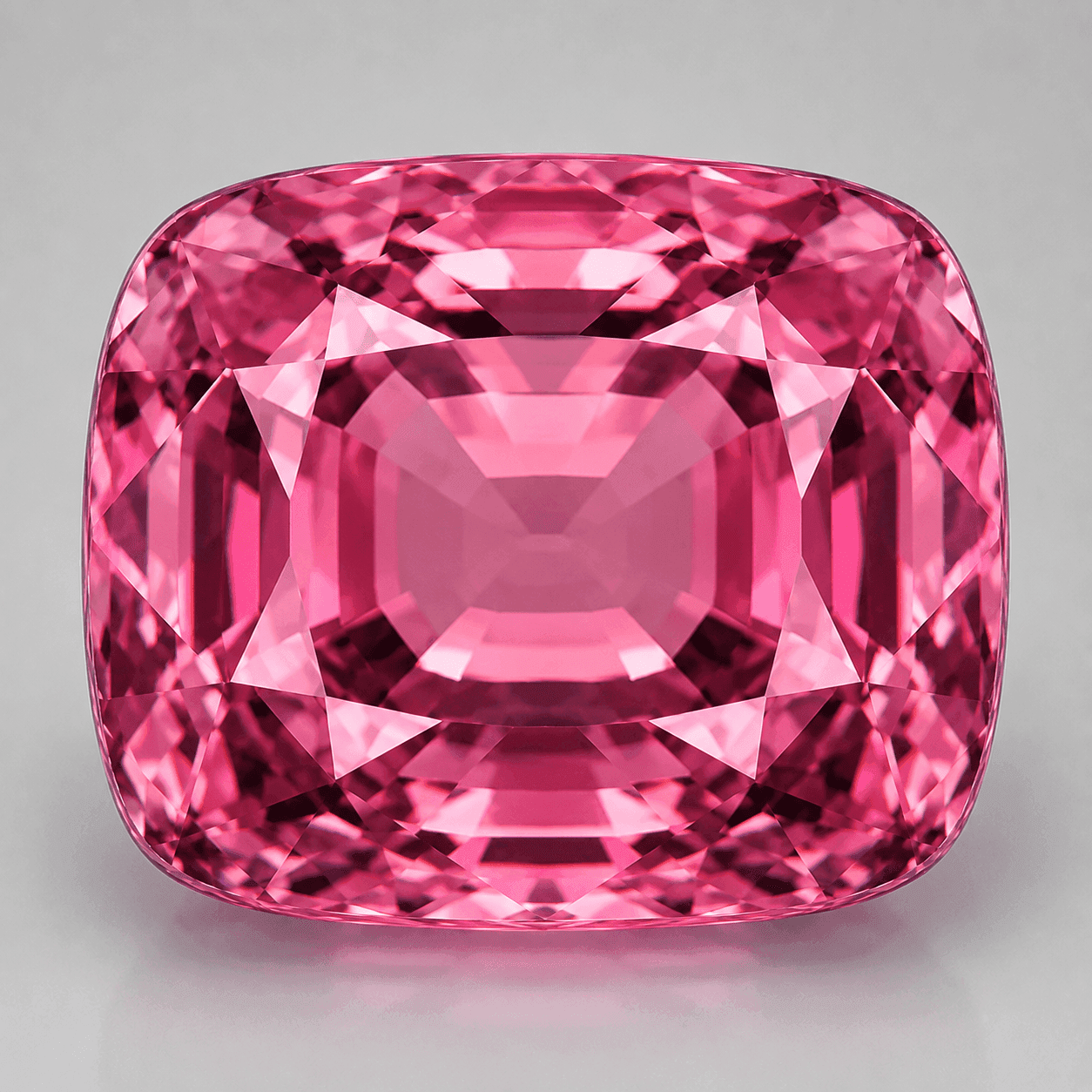
Hunza's hallmark is a bright, slightly cool pink - think fresh raspberry and rose rather than the warm, brownish-pink of some other sources. The best stones are vivid and glowing, with a lively transparency that comes from clean marble-hosted growth and low iron.
Colour in these stones is driven chiefly by chromium, the same trace element that colours ruby and the finest red spinel. Higher chromium pushes the pink toward true red; lower concentrations give the clear, candy-bright pinks Hunza is known for. Because the host marble is comparatively iron-poor, Hunza pinks tend to avoid the greyish or muddy cast that iron can introduce, and the cleanest examples fluoresce a strong red under ultraviolet - a lovely, if non-diagnostic, party trick that our guide to spinel fluorescence explains. For the full spectrum of what pink can mean across sources, see our pink spinel guide; if you are weighing a pink against a true red, pink versus red spinel lays out where one ends and the other begins.
True reds do come out of Hunza, and the very best rival material from more famous names - but they are a small fraction of production, usually in smaller sizes, and are exactly the stones that get quietly absorbed into the trade without an origin label. Clean stones above three or four carats are notable; anything larger and vivid is rare. Alongside the pinks and reds you will also see purple-leaning and orangey-pink stones, and occasional near-red crystals that reward a careful cutter. Because rough is often small and included, cutters prioritise colour and brightness over squeezing out maximum weight.
Hunza pink is the colour of a Karakoram sunrise on snow - bright, cool and impossibly clean.
How does Hunza compare with Tajik, Afghan and Burmese spinel?
Hunza sits in the middle of a family of marble-hosted deposits that share geology but differ in personality. It is best known for bright pink, whereas Burma leads on pigeon's-blood red and neon Jedi tones, Tajikistan for large historic reds, and Afghanistan for a broad pink-to-red range.
The table below sketches how a dealer holds these origins in mind. Treat it as tendency, not law - every deposit produces the occasional stone that behaves like its neighbour, which is precisely why origin matters but is never the whole story on value.
| Origin | Signature colours | Typical character | Trade note |
|---|---|---|---|
| Hunza (Pakistan) | Bright pink, some fine red | Clean, cool, vivid; often smaller sizes | Scarce; rarely labelled by origin |
| Kuh-i-Lal (Tajikistan) | Historic red / balas, pink | Large crystals, storied provenance | Ancient royal source; limited modern output |
| Badakhshan (Afghanistan) | Pink through red | Broad range, some warm tones | Long-worked marble belt |
| Mogok (Burma) | Pigeon's-blood red, hot pink, Jedi | Highest saturation, strong fluorescence | Benchmark for fine red spinel |
| Mahenge (Tanzania) | Neon pink-red | Electric, large clean crystals | Modern star of the pink-red market |
For the red end specifically, our red spinel guide sets out how saturation, tone and chromium determine value, and how fine red spinel still trades at roughly a tenth of a comparable ruby. And if you want the full family tree of where each colour and source fits, the complete guide to natural spinel is the place to start.
Is Pakistani spinel rare and valuable?
Yes - Hunza material is genuinely scarce, and fine examples are undervalued relative to their quality. Production is small and intermittent, most rough is modest in size, and clean, vividly saturated stones are the exception rather than the rule.
Value tracks the usual levers: colour first, then clarity, cut and size. A bright, clean Hunza pink of a carat or two occupies the same broad band as fine pink spinel generally, while the rare true reds command materially more per carat as they climb toward ruby-adjacent colour. The following ranges are consistent with our spinel price guide and reflect the 2026 market; they are indicative bands for natural, untreated material, not quotes or auction records.
| Grade | What you see | Indicative 2026 range (per carat) |
|---|---|---|
| Commercial pink | Lighter or slightly greyish, some inclusions | $150 - $500 |
| Fine pink | Bright, saturated, eye-clean, lively | $600 - $2,500 |
| Fine-to-vivid red | Chromium-rich, strong colour, clean | $2,000 - $10,000+ |
Size matters more here than at most deposits. Because Hunza rough tends to be small and the crystals often included, a clean, well-cut stone that holds vivid colour past two or three carats is disproportionately scarce, and price per carat climbs steeply as size and clarity rise together. Under a carat, fine pinks are attainable and make an excellent entry point into the origin; it is at the larger, cleaner end that competition with collectors sharpens and the true reds pull away from the field. For a sense of how weight interacts with rarity across colours, our carat size guide is a useful companion.
Two forces make Hunza a collector's value play. First, scarcity is real and one-of-one at the top: no two crystals cut alike, and the finest simply are not made in quantity. Second, the name carries less market premium than Burma or Mahenge, so you are often buying comparable beauty without paying for the label - a point we make in is spinel a good investment, always with the caveat that gemstones are collectibles, not guaranteed financial instruments. If Hunza's cool, bright pinks appeal, our pink collection is where to see them in the metal; for the chromium reds, browse the red collection.
Is Hunza spinel treated or heated?
Natural spinel is one of the very few coloured gems that is almost never treated, and Hunza material is no exception. What you see is what grew in the marble - no heating, no diffusion, no glass filling as standard practice.
This is worth dwelling on, because it is spinel's quiet superpower. Around ninety per cent of the blue sapphire on the market is heated; fine ruby is routinely treated; yet spinel's colour is stable from the ground and needs no help. Our dedicated explainer, is spinel treated or heated, covers the rare exceptions and how they are detected - but for Hunza pinks and reds, untreated is simply the norm. That said, the trade also imitates what it cannot mine: the real risks are man-made lab-created spinel sold as natural, and pink glass or synthetic corundum passed off as Pakistani spinel. Knowing how to tell if a spinel is real - its single refractivity, Mohs 8 hardness and lack of pleochroism - is the collector's best defence.
How do you buy Hunza spinel with confidence?
Buy on colour and light-return first, then verify identity and provenance. Because origin is rarely documented for Hunza, you are trusting a dealer's knowledge as much as any paper - so buy the stone, and buy the person selling it.
- Fix your colour target: decide whether you want a cool, bright pink (Hunza's specialty) or are chasing a rare chromium red, and judge saturation in daylight.
- Check brightness and clarity: hold the stone to the light - Hunza's appeal is glow and transparency, so favour eye-clean, lively stones over merely large ones.
- Confirm it is spinel: singly refractive, no facet-doubling, no pleochroism, Mohs 8, and often a red glow under UV; see our guide on how to tell if a spinel is real.
- Ask about origin honestly: expect 'consistent with Hunza' rather than a guarantee, and be wary of anyone claiming lab-certified origin on inexpensive material.
- Get a report for important stones: a lab report from a respected house confirms natural, untreated spinel, as our note on certification explains.
- Buy from a specialist: a dealer who handles spinel by colour and source will stand behind identity and treatment - the heart of how to buy natural spinel well.
For the broader mechanics of judging any spinel - the interplay of clarity, cut and shape and how they lift or flatten colour - lean on our buying guides, and cross-check pricing against independent references. The GIA spinel buyer's guide is a sound neutral primer on quality factors, and the mineralogical overview of spinel gives useful background on the species and its geology.
Handled with a little knowledge, Pakistani spinel offers something increasingly hard to find: a natural, untreated, marble-hosted gem of real beauty, from a named Himalayan valley, at a price that has not yet caught up with its rarity. That is exactly the kind of quiet, one-of-one opportunity the connoisseur is meant to notice before everyone else does.
- Where is Pakistani spinel mined?
- Almost all of it comes from the Hunza Valley in Gilgit-Baltistan, high in the Karakoram range of northern Pakistan. The deposits are marble-hosted and sit on the same ancient gem belt as Tajikistan's Kuh-i-Lal and Afghanistan's Badakhshan mines.
- What colour is Hunza spinel?
- Predominantly a bright, slightly cool pink coloured by chromium, ranging from candy-pink to raspberry, with a smaller number of fine chromium reds. The cleanest stones are highly transparent and can glow red under ultraviolet light.
- Is Hunza spinel treated or heated?
- No - like nearly all natural spinel, Hunza material is untreated. It needs no heating or diffusion, which sets it apart from most sapphire and ruby on the market. The main risks are lab-created spinel or glass sold as natural.
- How much does Pakistani spinel cost?
- Indicatively in 2026, commercial pinks run roughly $150-500 per carat, fine bright pinks about $600-2,500, and rare fine-to-vivid reds $2,000-10,000 or more. Colour, clarity, cut and size drive the price; these are ranges, not quotes.
- Is Hunza spinel a good buy for collectors?
- For many, yes: it is genuinely scarce, almost always untreated, and carries less name-premium than Burma or Mahenge, so you often get comparable beauty for less. As with all gems, treat it as a collectible rather than a guaranteed investment.
Sources
Facts on this page draw on independent gemmological authorities:
- Gemological Institute of America (GIA) · Institute
- Gübelin Gem Lab · Laboratory
- GRS (GemResearch Swisslab) · Laboratory
- Lotus Gemology · Laboratory